
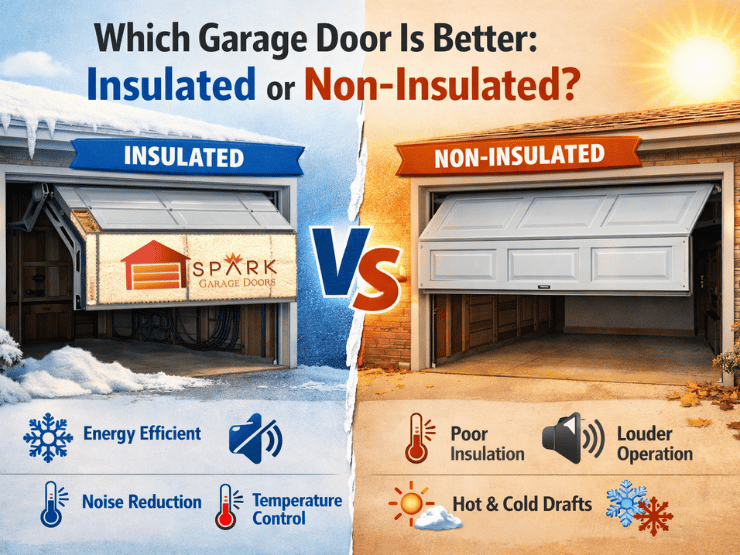
An Honest Comparison of Insulated and Non-Insulated Garage Doors
Most homeowners end up deciding between insulated and non-insulated garage doors. Both can open and close reliably. Both can look great from the curb. But the difference in day-to-day experience is bigger than people expect.
What “insulated” actually means in a garage door
An insulated garage door is typically built with multiple layers. Instead of a single sheet of steel, it often has an outer steel skin, a core of insulation, and sometimes an interior backing layer. The insulating materials inside the door are what slow heat transfer and help the garage stay more stable throughout the day. Two common options are polystyrene and polyurethane insulation. Polyurethane insulation is often valued because it can deliver strong thermal performance in a thinner profile, which helps the door feel more solid and efficient without becoming bulky.
A non-insulated door is usually a single-layer steel door. It’s lighter and simpler, which is why it has a lower initial cost. But it does not do much to manage temperature or noise, and it can be easier to dent.
The biggest difference: temperature comfort and energy efficiency
Insulated doors are better at keeping outside temperatures from taking over your garage. In winter, they reduce how quickly cold air chills the space. In summer, they help slow down heat buildup, especially if your garage door gets direct sun for hours. The benefit you notice most is fewer temperature fluctuations inside the garage. Instead of swinging from “icebox” to “oven” within the same day, the space stays closer to a steady middle.
This matters most when your garage is attached to your home or when there’s a bedroom above it. Even if you never “heat the garage,” an attached garage shares walls with living space. When the garage swings wildly in temperature, that heat transfer affects nearby rooms and can make your HVAC system work harder to maintain comfortable indoor conditions. Over time, that can show up in energy expenses and higher monthly energy bills.
With a detached garage, you may not care as much about comfort unless you use the space regularly. But if you store paints, electronics, tools, or anything sensitive to extreme temperatures, insulation can still be valuable.
Noise reduction: the benefit you notice immediately
If your garage is under a bedroom, near a nursery, or close to a home office, noise matters. Non-insulated doors are usually louder because a thin steel panel vibrates more. You often hear more rattling, more echo, and more of that hollow “clang” as it moves.
Insulated doors tend to be quieter because the thicker, multi-layer construction dampens vibration. In practice, the insulated core acts like a sound barrier, reducing the sharpness of vibrations and limiting how much noise travels into adjoining rooms. If you leave early in the morning or come home late, this is one of those upgrades you appreciate every single day.
Durability and dent resistance: why insulated doors feel “stronger.”
A non-insulated single-layer door is more likely to dent from an accidental bump, a basketball, or a minor impact from a bike handlebar. Those dents can be cosmetic, but they can also affect how the door sits and seals over time.
Insulated doors generally have better structural strength because of the layered build. They resist denting better, hold their shape more reliably, and often feel sturdier in wind and weather. This is especially important if your garage faces strong winds or if your door is exposed to harsh sun and temperature swings.
Curb appeal and how the door changes the look of your home
Garage doors take up a large portion of your home’s front-facing exterior, so curb appeal is not a small thing. The right door style and finish can make the home feel more modern, more polished, and more cohesive. While insulation itself is mostly a performance feature, insulated doors often come in more premium construction options, which can translate into a more substantial, higher-quality look and feel.
For homeowners who care about resale, a garage door upgrade is often seen as a visible improvement. The combination of better performance and improved appearance can contribute to property value, especially if the door makes the exterior look updated and the garage feel more usable.
What about the garage door opener and hardware?
Door weight and balance matter for performance. Non-insulated doors are lighter, which can be easier on a garage door opener in some situations. Insulated doors are heavier, but they are also typically paired with appropriate springs and hardware designed for that weight.
In real-world terms, a properly installed insulated door should not “strain” your system. The key is a professional setup and correct spring sizing. A good garage door opener and properly tuned springs do most of the lifting. If your current opener is older or underpowered, upgrading the door may be a good moment to evaluate the opener, too, so everything works smoothly together.
Initial cost vs long-term value
This is usually where the debate lands. Non-insulated doors win on initial cost. If you’re on a tight budget, or if the garage is detached and used mainly for parking with little time spent inside, a non-insulated door can be a reasonable choice.
Insulated doors cost more upfront, but they often feel like a higher-quality product. Many homeowners find that the comfort benefits, quieter operation, and reduced energy expenses help justify the difference. It’s not always about “payback” in a strict financial sense. It’s about daily livability, especially in homes where the garage is part of the flow of life.
When an insulated garage door is usually the better choice
If your garage is attached, if you have living space above it, or if you spend time in the garage doing hobbies, workouts, or projects, an insulated door is usually the better investment. It keeps the space more stable, reduces noise with a built-in sound barrier, and tends to hold up better over years of use.
If you live in an area with extreme hot summers or cold winters, insulation also becomes more valuable because the garage is constantly fighting outdoor conditions.
When a non-insulated garage door can still make sense
If your garage is detached, you live in a mild climate, and you primarily use the garage as a simple parking space with minimal time spent inside, a non-insulated door can do the job at a lower initial cost.
It can also make sense for short-term situations where budget is the priority and you plan to upgrade later. Just be aware that you’re trading comfort, noise control, and durability for the lower price.
The practical way to decide
Ask yourself how you actually use the garage. Do you walk through it daily into the house? Do you store valuables, tools, or temperature-sensitive items? Do you care about noise in nearby rooms? Do you want a space that feels usable year-round?
If your answer is yes to any of those, insulated is usually the better fit. If the garage is simply a detached storage spot and cost is the key driver, non-insulated can be fine.
The Final Verdict
For most modern homes, an insulated garage door is the better overall choice. It delivers better temperature regulation, improved energy efficiency, quieter operation, and stronger durability. Non-insulated doors still have a place, but they’re best treated as a budget-focused option for detached garages or mild climates.
Beyond comfort, an insulated door can be one of those upgrades that improve how the home feels and functions while supporting curb appeal and potentially boosting property value.
Spark Garage Doors Centennial can help service both insulated and non-insulated garage doors in Arapahoe County. Get in touch with us for quick and affordable solutions.