
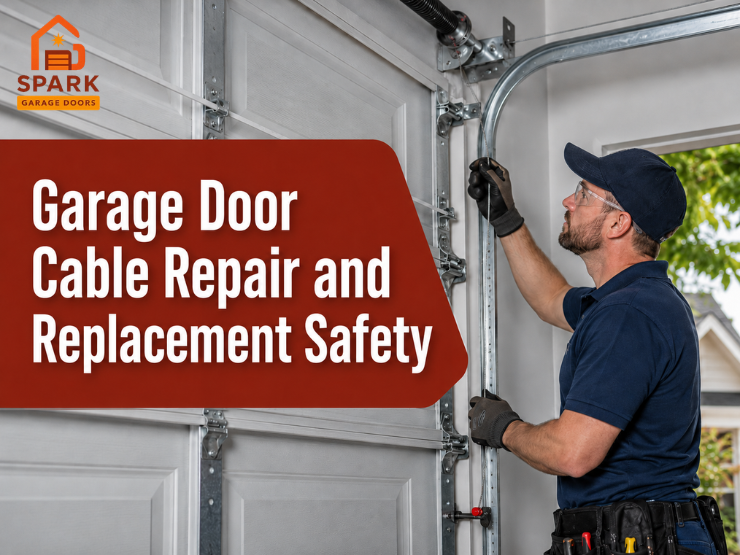
Why Garage Door Cables Fail at the Worst Possible Time
If you’re staring at a loose cable and wondering whether to grab tools or call a technician, you’re asking the right question. Some cable issues are straightforward. Others are high-risk and should be handled by a professional.
What a Garage Door Cable Problem Looks Like
Cable problems usually show up in obvious ways. The door may lift unevenly, with one side higher than the other. You might hear a sharp snap or a grinding sound near the drum. The door may jam or look “twisted” in the opening. You may also see the cable hanging loose near the track or wrapped incorrectly around the drum.
If the cable is frayed or visibly broken, treat it as a stop-now situation. Operating the door with a damaged cable can cause the door to bind, fall unevenly, or damage the track and panels.
The Big Safety Issue You Must Understand First
Garage door cables are part of a system that includes torsion springs or extension springs. Those springs are under significant tension. Releasing or adjusting that tension incorrectly can cause serious injury.
A quick rule that keeps people safe is this: if your repair requires loosening torsion spring set screws, adjusting spring tension, or working near a loaded spring system without proper winding bars and experience, it’s time to hire a professional.
DIY can be reasonable when the cable has simply slipped off the drum and you know how to secure the door safely. DIY is not a good idea when a cable is snapped, frayed, or when the door is unbalanced and heavy.
DIY or Hire a Pro: The Practical Decision Guide
DIY can be appropriate if the cable has slipped off the drum or pulley, the cable itself is intact, and you have experience working around garage doors. You still need to secure the door, keep hands clear of pinch points, and avoid spring adjustments unless you truly know what you’re doing.
Hiring a professional is strongly recommended if the cable is snapped or frayed, if you do not have winding bars, if you’re unfamiliar with tension springs, if the door feels heavy or unbalanced, or if the drum and shaft area looks damaged. It’s also the smarter option if the door is stuck halfway and you can’t safely stabilize it.
If you’re unsure which category you’re in, choose the safer one. Cable repairs can go wrong quickly.
Fast DIY Checks Before You Touch Anything
Start by disconnecting power to the opener. Unplug it or turn off the breaker. Then pull the emergency release so the opener cannot move the door unexpectedly.
Look closely at the cable condition. If you see fraying, rusted strands, or a clean break, stop and call a professional. If the cable looks intact and simply jumped the drum grooves, you may be dealing with a slip rather than a failure.
Also look at the door position. A door that is crooked in the opening is under uneven load. Do not force it with the opener.
How to Fix a Loose Cable Quickly
If you are experienced and the cable has only slipped, the safest approach begins with stabilizing the door.
Raise the door to the fully open position if it can be moved safely, because that reduces load at the bottom brackets and helps stabilize the system. Then clamp the tracks using vice grips just below the bottom rollers so the door cannot drop.
Once the door is secure, inspect the cable path from the bottom bracket up to the drum. Many times the cable has come off the drum grooves and is sitting loose.
At this stage, many repairs require relieving spring tension to reseat the cable properly. This is where the line between DIY and professional work becomes very real. Releasing torsion spring tension must be done with proper winding bars, controlled quarter-turn movements, and a clear understanding of the set screw and winding cone system. Never use screwdrivers in place of winding bars. Never loosen set screws unless the winding bars are properly seated and you are in complete control of spring force.
If you are not fully confident in this step, stop and call a professional. It is not the place to learn by trial and error.
If you do proceed and you safely relieve tension, you can unhook the cable from the bottom bracket, remove it from the drum, and thread it back correctly so it wraps cleanly in the drum grooves. Then you re-tighten the drum set screws, re-tension the springs, remove the track clamps, and test the door by hand.
The key detail that prevents repeat problems is making sure the cable is seated neatly in the grooves, with even tension on both sides, before you reapply spring force.
Why Replacing Both Cables Matters
Even if only one cable looks damaged, cables wear as a pair. They experience the same cycles, and when one fails, the other is often not far behind. Replacing both cables at the same time helps ensure even tension, smoother lifting, and fewer future failures.
It also reduces the chance of the door lifting unevenly, which is one of the main triggers for drums losing the cable or the door tracking poorly.
How to Test the Door After Any Cable Work
After the cable is reseated or replaced and the system is back together, test the door manually before reconnecting the opener.
Lift the door halfway and release it carefully. A properly balanced door should stay in place. If it drops quickly or feels heavy, the spring tension may be incorrect or there may be another issue that caused the cable problem in the first place.
Also check that both sides of the door rise evenly and that the cables wrap cleanly on the drums without overlapping.
If anything feels rough, uneven, or unstable, stop and call a professional. Forcing a bad balance situation can damage the opener and the door.
Common Reasons Cables Come Off or Break
Cables often fail because of wear and corrosion, especially in humid climates. They can also slip when the door is out of balance, when drums are loose, when bearings are worn, or when the door tracks are misaligned.
A door that has been operating with poor balance for a while puts extra strain on cables. That strain can pull a cable out of the drum grooves or accelerate fraying. Sometimes the cable problem is a symptom of a spring problem or a tracking problem.
When a Professional Repair Is the Best “Quick Fix”
If your goal is the quickest safe outcome, professional help is often faster than DIY when springs are involved. A technician can replace cables, check drums and bearings, confirm spring balance, and test the system under load without guesswork.
It also reduces the risk of injury. The cost of professional repair is often far less than the cost of dealing with a damaged door, a burned-out opener, or a preventable accident.
Garage Door System Repair in Centennial
A garage door cable issue is one of those problems where “quickly” should never mean “recklessly.” If the cable is intact and simply slipped, a skilled DIYer may be able to reseat it, but only with the door secured and spring tension handled correctly using proper winding bars. If the cable is frayed or snapped, or if you’re unfamiliar with torsion springs, hiring a professional is the safest and often the fastest path to a reliable fix.
Please note that garage door repairs can be dangerous due to high-tension springs and heavy moving parts. If you are uncomfortable with any step, contact a qualified professiona like Spark Garage Doors. Get in touch with us if you need garage door repair service in Centennial or its surroundings.