
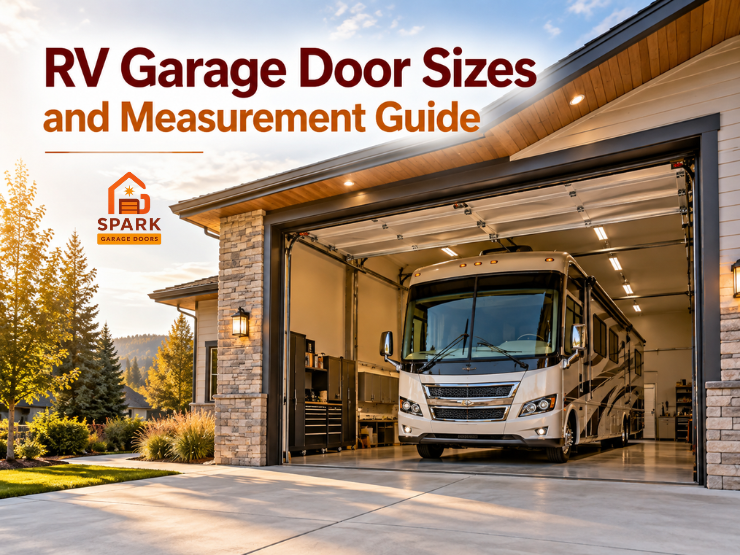
For Centennial homeowners planning an RV garage, choosing the correct door size also affects the structure, tracks, springs, opener, insulation, garage door frame, and ultimately the cost of the project. At Spark Garage Doors Centennial, we recommend starting with the RV itself rather than choosing a door size based solely on a general chart or Design Centre configuration.
This guide covers common RV garage sizes, factors affecting prices, clearance requirements, and the measurements you should take before ordering an oversized door.
What Is a Standard RV Garage Door Size?
Unlike ordinary residential doors, RV garage doors don’t have one universal standard size. A 14-foot-wide by 14-foot-high opening is a common choice for larger RV garages because it provides generous clearance for many motorhomes. However, that doesn’t automatically make 14 × 14 feet the correct size for every property.
Smaller Class B motorhomes and camper vans may fit through openings much closer to conventional residential dimensions. Class C motorhomes generally require more height, while large Class A motorhomes can require substantially taller and wider openings.
Travel trailers and fifth wheels create another consideration: the tow vehicle and trailer combination needs sufficient maneuvering room in front of the opening, even when the trailer itself fits comfortably through the door. The same applies if the garage is also intended to accommodate pickup trucks or other oversized vehicles.
The correct size should therefore be determined from the largest vehicle you realistically expect to store.
Common RV Garage Sizes by Vehicle Type
Class A motorhomes are among the largest recreational vehicles and commonly justify openings around 12 to 14 feet high or more. A wider opening can make parking significantly easier, particularly when large side mirrors are involved.
Class B motorhomes are considerably smaller. Depending on the specific vehicle and rooftop accessories, some may work with openings closer to traditional residential garage sizes.
Class C RVs fall between the two. Their cab-over design and rooftop equipment mean height should be measured carefully rather than estimated from the chassis.
Fifth wheels and travel trailers vary enormously. Roof-mounted air conditioners, vents, antennas, solar installations, and satellite equipment can make the actual clearance requirement considerably different from the trailer body’s listed dimensions.
Rather than treating vehicle-class dimensions as exact specifications, use them as a starting point. The physical measurement of your particular RV should determine the final opening.
How to Measure an RV for the Correct Garage Door
Begin by parking the RV on a flat surface and measuring its maximum width and maximum height in its normal travel configuration.
For width, don’t measure only the body. Consider mirrors, awnings, handles, slide-out components when relevant, and anything else that projects beyond the sides. Some mirrors fold inward, but relying on extremely tight clearance every time you park can become inconvenient.
Height requires even more attention. Measure to the highest fixed point, including rooftop air-conditioning equipment, vents, antennas, satellite equipment, solar panels, racks, or other permanently installed accessories.
Don’t assume the manufacturer’s published vehicle height represents your current configuration. Aftermarket equipment may have changed it.
Then add practical clearance. An opening exactly equal to the RV’s dimensions technically doesn’t fit in any useful sense. Additional space reduces the chance of damaging mirrors, rooftop equipment, the door jamb, or the RV itself.
How Much Clearance Does an RV Garage Door Need?
There is no single clearance number appropriate for every installation, but additional space around the vehicle is strongly preferable to designing around an exact fit.
For example, if an RV is close to 12 feet high, choosing a 12-foot opening leaves essentially no margin for changes in pavement elevation, suspension movement, accessories, or measurement error. A taller opening provides considerably more practical protection.
Width should receive the same treatment. Extra side clearance makes it easier to line up the RV and reduces the risk of striking mirrors, trim, or the garage door frame.
Think beyond the opening as well. The driveway or approach needs enough room to straighten a large vehicle before it enters. A generously sized door can still be frustrating if the approach angle forces you to maneuver a long motorhome, trailer, or pickup truck through it at an awkward angle.
Don’t Forget the Door Jamb, Headroom, and Garage Door Frame
Door opening size is only part of the calculation. An oversized sectional door also needs sufficient room above and around the opening for tracks, springs, hardware, and potentially an automatic opener.
The door jamb and garage door frame must be properly sized, square, and structurally capable of supporting the installed system. A poorly framed opening can complicate installation, affect sealing, and interfere with smooth operation.
A 14-foot-high opening, for example, doesn’t mean a 14-foot-high building is adequate. The structure needs additional vertical space for the door system.
The exact headroom requirement depends on the door configuration and hardware. Standard-lift, high-lift, and other track arrangements have different space requirements. Building design, ceiling height, beams, lighting, HVAC equipment, and storage systems can all affect what is possible.
The Roof profile & pitch should also be considered during planning. Roof geometry can influence available interior headroom, track placement, and whether a high-lift or alternative track configuration will fit properly.
This is why track layout should be planned before construction or remodeling is finalized rather than after the opening has already been framed.
How Much Does an RV Garage Door Cost?
RV garage doors generally cost more than conventional residential doors because they require more material and may need heavier-duty hardware. However, quoting one universal price range is misleading because oversized doors can differ dramatically in specifications.
Size is the obvious cost factor. A wide, 14-foot-high insulated door requires more material than a typical residential door. Door construction also matters. Insulated metal panels, steel thickness, reinforcement, decorative finishes, windows, and custom designs can all raise the price.
Hardware is another factor. Larger doors may require upgraded springs, tracks, rollers, reinforcement, and an opener appropriate for the door’s specifications and usage.
Custom track arrangements can further affect the installation cost. High-lift configurations, unusual ceiling conditions, or structural modifications can make one RV door installation considerably more complex than another.
Instead of budgeting from the door panel price alone, consider the complete installed system.
Are Insulated Metal Panels Worth It for an RV Garage?
For Centennial’s seasonal temperature changes, insulation deserves serious consideration, especially if the garage is attached to the home, heated, used as a workshop, or intended to protect the RV during colder months.
Insulated metal panels can reduce heat transfer and generally provide a more substantial barrier between the garage and outdoor conditions. They can also add rigidity and may contribute to quieter operation compared with basic single-layer construction.
However, additional insulation can increase the door’s overall weight. Springs, tracks, and opener specifications therefore need to match the complete door rather than being selected independently.
Weather seals around the perimeter and bottom of the opening are also important. An expensive insulated door won’t perform as intended if substantial gaps around the door jamb allow drafts, moisture, and debris inside.
Choosing an Opener for a Large RV Garage Door
An oversized door shouldn’t simply be paired with whatever opener happens to have the highest advertised horsepower.
A properly balanced door is primarily supported by its spring system. The opener controls movement; it shouldn’t be compensating for an improperly balanced or excessively heavy door.
Door weight, height, track configuration, cycle frequency, and manufacturer specifications should determine opener selection. Some tall garages may also benefit from alternative opener configurations that preserve overhead space.
Safety features matter just as much as lifting capability. Photo-eye sensors, proper travel limits, force settings, and emergency release operation should all be correctly configured.
Plan Garage Sizes Around Future Vehicles
One of the easiest mistakes to make is designing the garage around the RV you own today without considering what might replace it.
If the structure allows it, additional height and width can provide flexibility for a future motorhome, fifth wheel, boat, pickup truck, roof rack, or other oversized vehicle. Enlarging an opening during the original design stage is generally much simpler than modifying a finished structure later.
That doesn’t mean every homeowner needs a massive 14 × 14-foot opening. It means garage sizes should account for realistic future needs rather than creating the smallest opening that accommodates the current vehicle.
Choosing the Right RV Garage Door Size in Centennial
The best RV garage door size isn’t determined by a generic chart. Start with the actual height and width of your vehicle, include mirrors and rooftop accessories, add practical clearance, and then evaluate the garage’s headroom, door jamb, garage door frame, track configuration, Roof profile & pitch, ceiling, approach, and structural limitations.
For larger motorhomes, a 14 × 14-foot opening can provide comfortable clearance, but smaller or larger configurations may make more sense depending on the RV and property. Getting these measurements right before ordering can prevent expensive modifications and make daily parking substantially easier.
If you’re planning an RV garage in Centennial or need help determining the appropriate garage sizes, door configuration, insulation, hardware, or opener requirements, contact Spark Garage Doors Centennial for professional guidance and installation.