
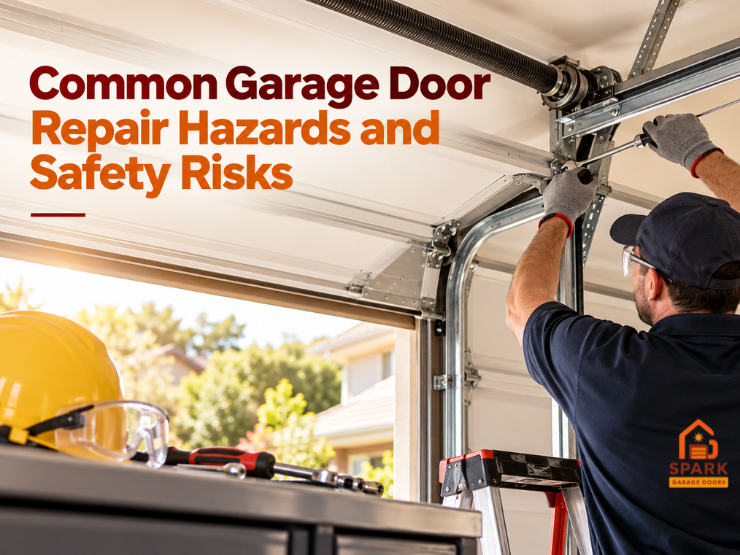
At Spark Garage Doors Centennial, we regularly deal with problems involving broken springs, damaged cables, misaligned tracks, malfunctioning openers, and safety sensors. What makes these repairs different from many ordinary household projects is the combination of a heavy moving door and components that can be under significant tension.
Understanding where the hazards are can help you decide what you can safely inspect yourself and when it’s better to stop using the door and have the problem professionally diagnosed.
Why Can Garage Door Repair Be Dangerous?
A residential garage door can weigh hundreds of pounds depending on its size, construction, insulation, windows, and other features. Yet when the system is properly balanced, you may be able to move it with relatively little effort.
The springs make this possible by counterbalancing much of the door’s weight. That also means the spring system stores substantial mechanical energy. Cables, drums, brackets, rollers, tracks, and other components work together to control that weight as the door moves.
When one of these components fails, the forces in the system can change suddenly. A repair that looks as simple as loosening a bolt or removing a bracket can therefore have consequences that aren’t obvious to someone unfamiliar with the mechanism.
Broken Garage Door Springs and Stored Energy
Broken springs are among the most common problems we encounter. A torsion spring sits above the opening on many systems and is wound to provide the torque necessary to counterbalance the door.
A spring may eventually weaken and break after repeated cycles. Homeowners sometimes hear a loud bang when this happens and later discover that the opener struggles to lift the door or that the door feels unusually heavy.
The dangerous part is attempting to adjust, unwind, or replace a torsion spring yourself. Specialized winding tools and specific procedures are used because uncontrolled spring movement can cause serious injury.
When we address a spring problem, we first identify the spring system, inspect the related hardware, secure the door appropriately, and determine whether other components have been affected. Spring replacement is one repair we recommend leaving to trained technicians.
Frayed or Broken Garage Door Cables
Lift cables carry substantial loads as the door opens and closes. A cable that is fraying, loose, corroded, or improperly seated on the drum can cause the door to become crooked or stop moving correctly.
One mistake is assuming that a loose cable can simply be pulled back into position. Cable tension is connected to the spring system, and interfering with bottom brackets, drums, or tensioned cables can be hazardous.
When repairing cable-related problems, we look beyond the cable itself. Springs, drums, pulleys where applicable, brackets, tracks, and door alignment should also be checked. Replacing a cable without identifying why it failed can leave the underlying problem unresolved.
An Uneven or Suddenly Falling Garage Door
If one side of the door rises faster than the other, the door appears crooked, or it unexpectedly drops, stop operating it.
An uneven door can indicate a cable problem, spring failure, damaged roller, track issue, or another imbalance. Continuing to cycle the opener may place additional stress on the remaining components and potentially make the damage worse.
The emergency release cord also needs caution. Disconnecting the opener doesn’t make a damaged door safe. If the spring system isn’t supporting the weight correctly, releasing the opener while the door is raised can allow the door to move unexpectedly.
Before manually disconnecting a malfunctioning system, a technician can evaluate whether the door is adequately supported and secure it when necessary.
Loose Brackets, Tracks, and Overhead Components
Garage door hardware experiences vibration and repeated loading during normal operation. Over time, fasteners may loosen, tracks can shift, and brackets can become damaged.
Some visible hardware can be inspected without touching it. However, homeowners shouldn’t assume every loose bolt should simply be tightened. Certain brackets and components are connected to tensioned parts of the system.
There is also the basic risk of working at height. Opener motors, tracks, and overhead hardware often require ladder access. Combining a ladder with heavy equipment and moving components creates another potential source of injury.
Our approach is to determine why a component moved or loosened before making adjustments rather than treating the visible symptom alone.
Garage Door Safety Sensor Problems
Not every repair carries the same level of risk. Photo-eye sensor troubleshooting is one area where homeowners can safely perform some basic checks.
Modern automatic openers use external entrapment-protection devices, commonly photo-eye sensors positioned near the bottom of the opening. If the beam is interrupted or the system detects a problem, the door should not close normally.
If your door starts closing and reverses, inspect the opening for an obstruction. You can also carefully clean dirty sensor lenses and check whether the sensors appear to have been bumped out of alignment.
Never bypass or disable a safety sensor to make the opener work. If cleaning and basic checks don’t solve the problem, the sensor, wiring, alignment, opener settings, or another component may require further diagnosis.
Older opener systems may also lack safety features expected on modern residential installations. In those cases, replacement may make more sense than repeatedly repairing obsolete equipment.
When a Garage Door Opener Is the Real Problem
A door that won’t move isn’t automatically suffering from a broken opener. The opener is only one part of the system.
For example, a broken spring can make the door too heavy for the opener to lift. Repeatedly pressing the remote can then place unnecessary strain on the motor and drive mechanism. Similarly, damaged tracks, rollers, or cables can interfere with movement even when the opener itself is functioning.
Before replacing an opener, we determine whether the door moves correctly and whether the counterbalance system is working as intended. Diagnosing the entire system first can prevent replacing a component that wasn’t responsible for the original problem.
Garage Door Maintenance Homeowners Can Safely Handle
Professional service doesn’t mean homeowners should ignore their doors between appointments. Simple observation and preventive maintenance can reveal developing problems early.
You can listen for new grinding, scraping, popping, or squeaking sounds and visually inspect rollers, cables, tracks, weather seals, and other accessible components without disassembling them. Keeping the sensor area clear and gently cleaning photo-eye lenses are also straightforward tasks.
Lubricating manufacturer-approved moving components can be part of routine maintenance when performed according to the door manufacturer’s instructions.
You can also observe whether the door moves smoothly and closes evenly. If something suddenly changes, don’t keep operating the system hoping the problem will disappear.
Garage Door Repairs You Should Not Attempt Yourself
The dividing line is fairly simple: avoid DIY work involving stored spring tension, load-bearing cables, bottom brackets, or an unstable door.
Torsion spring replacement and adjustment, cable replacement, drum work, repairs involving tensioned brackets, and structural track problems generally require professional tools and procedures. A door that is hanging crookedly, partially detached, or at risk of falling should also be left alone until it can be properly secured.
Saving the cost of a service call isn’t worthwhile if the repair exposes you to a falling door or an uncontrolled tensioned component.
Keeping Your Centennial Garage Door Safe
Garage door repair isn’t inherently dangerous in every situation. Cleaning a sensor lens and replacing a remote battery are low-risk tasks. Working on a loaded torsion spring is a completely different matter.
The safest approach is to understand that distinction. Watch for unusual noises, uneven movement, frayed cables, damaged hardware, delayed reversal, and sudden changes in how the door feels or operates. Addressing these warning signs early can prevent a relatively small problem from becoming a larger mechanical or safety issue.
If your garage door in Centennial has a broken spring, damaged cable, uneven movement, opener problem, or another issue you’re not comfortable handling safely, contact Spark Garage Doors Centennial for an inspection and professional garage door repair.